TOPIC 3
Classify and Count Data
OVERVIEW
In Topic 3, your child will sort up to 10 objects into categories. After sorting, your child will count the number of objects in each group and then compare those numbers.
SORT OBJECTS
Your child will sort pictures of objects into two groups. One group will be objects that have a certain attribute (or characteristic), and the other group will be objects that do NOT have that attribute.
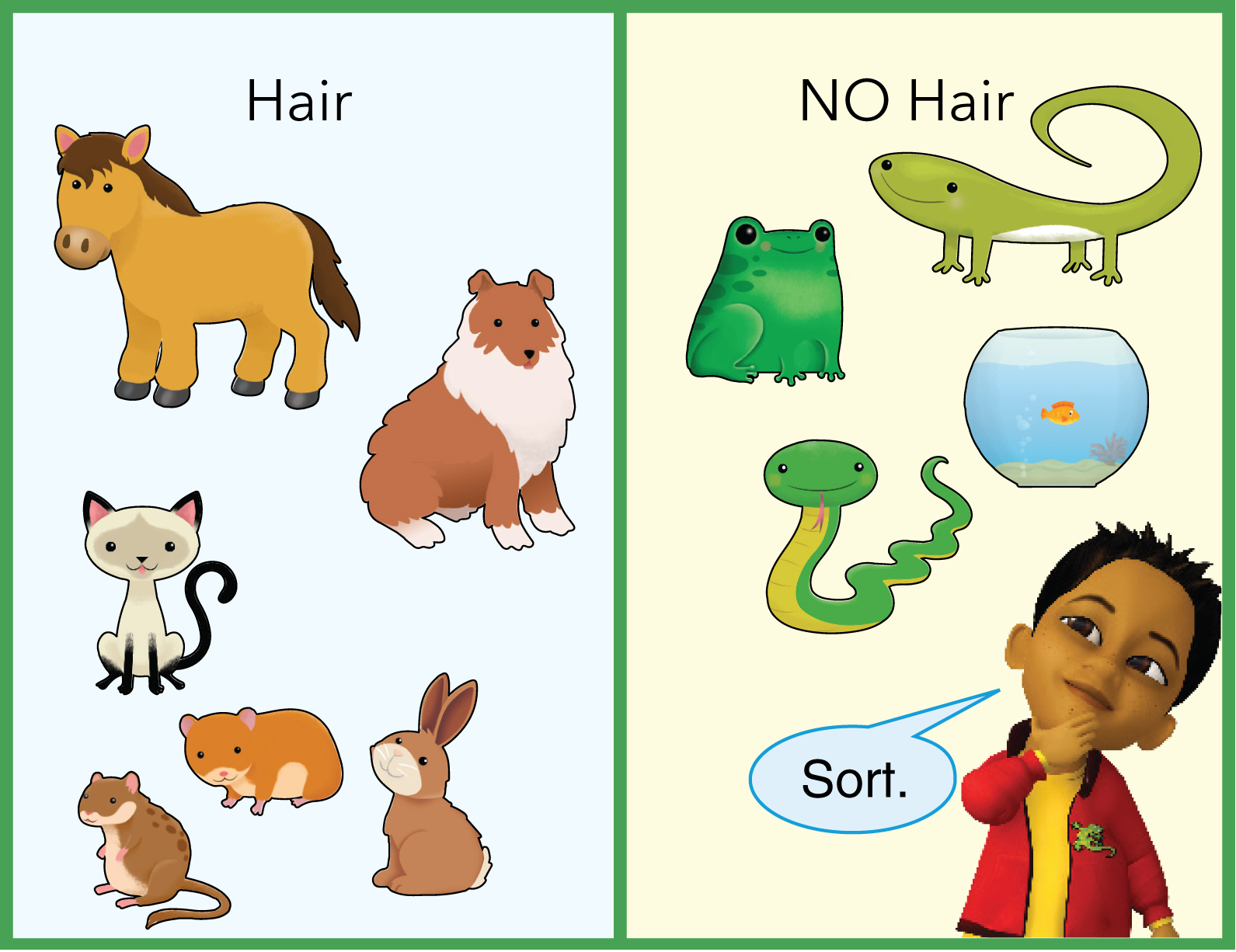 A horse, dog, cat, hamster, gerbil, and rabbit are in the Hair group. A lizard, frog, fish, and snake are in the No Hair group. A child looks at the groups and says Sort.
Your child will circle objects with a given attribute (such as “has feathers”) and mark an X over objects that do not have that attribute.

COUNT, RECORD, AND SORT
Count and Record the Number in Each Group Your child will count the number in each group (having an attribute and not having that attribute) and record the number for each group in a chart. Recording can be done by first making tally marks in the chart and then writing the numerals.
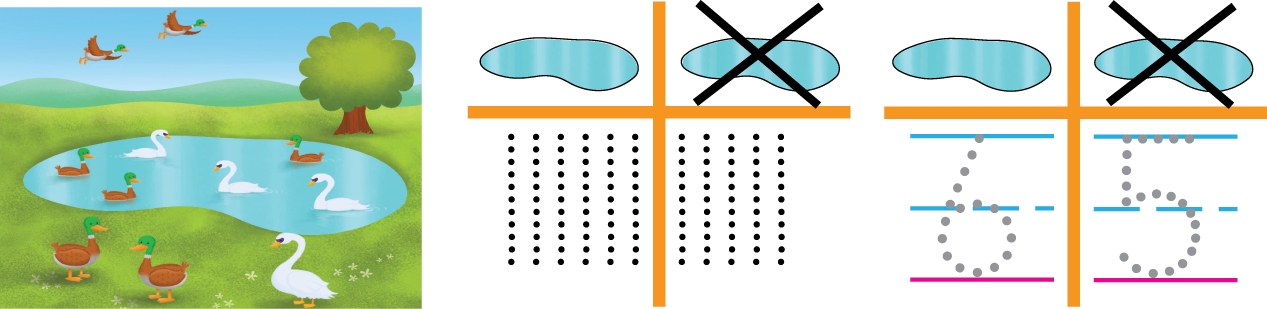 One chart has dot prompts for 6 tally marks for water and 5 tally marks for no water. The other chart has dot prompts for the number 6 for water and the number 5 for no water.
Sort the Categories Your child will compare the unequal numbers of objects in the two groups they were sorted into and identify which group is greater in number or which is less in number. Your child will circle the group that is less in number and explain how they know.
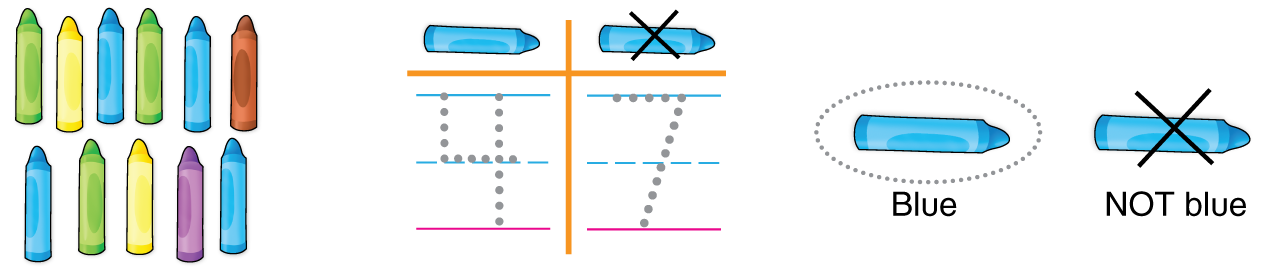 A two-column chart has dot prompts for the number 4 under a blue crayon and the number 7 under a not blue crayon. There is a dot prompt to circle a blue crayon. A not blue crayon is marked with an X.
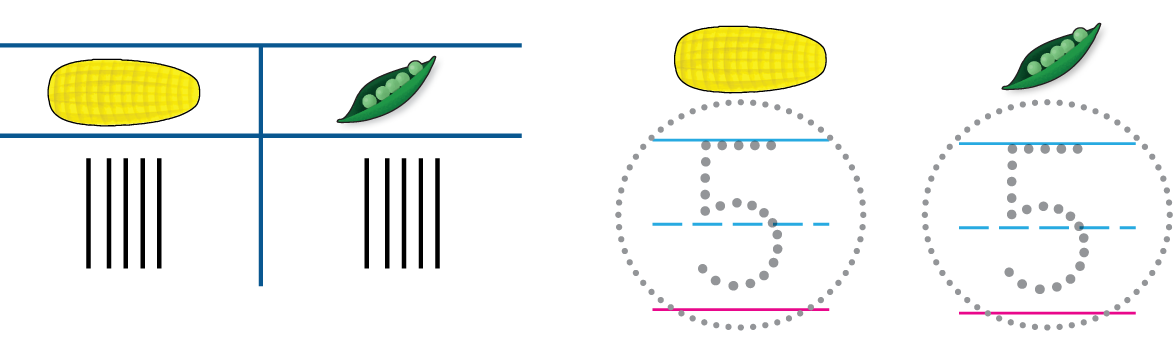
When groups of sorted objects are equal in number, your child will circle both numbers.
CONNECT THE MATH
You can connect the math in this topic to everyday experiences. Have your child sort objects at home into groups that have and do not have attributes you decide on. For example: clothes that have buttons/clothes that do not have buttons; toys that have wheels/toys that do not have wheels; crayons that are broken/crayons that are not broken. Your child can count the objects (up to 10) in each group and tell which group is greater in number or less in number than the other group. You can also sort the objects yourself and have your child guess the categories.
Topic 3 Lessons
-
Lesson 3-1
-
Lesson 3-2
-
Lesson 3-3
-
Lesson 3-4
-
Lesson 3-5
-
Lesson 3-6
-
Lesson 3-7
-
Lesson 3-8