TOPIC 5
Understand Subtraction
OVERVIEW
Topic 5 introduces your child to the concept of subtraction and focuses on understanding subtraction as “take apart” and “take from.” Your child will learn to represent subtraction in different ways and use subtraction to solve real-world problems. The work in this topic builds toward fluently subtracting within 5.
MEANINGS OF SUBTRACTION
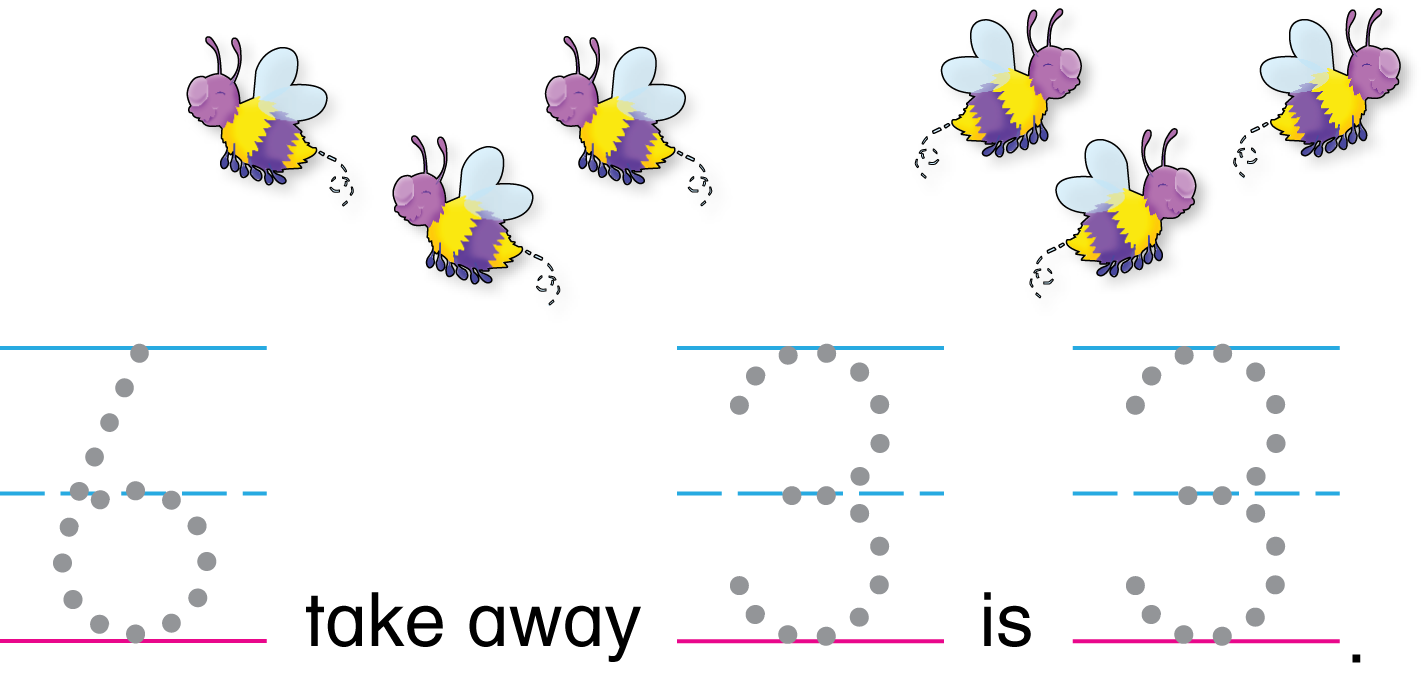
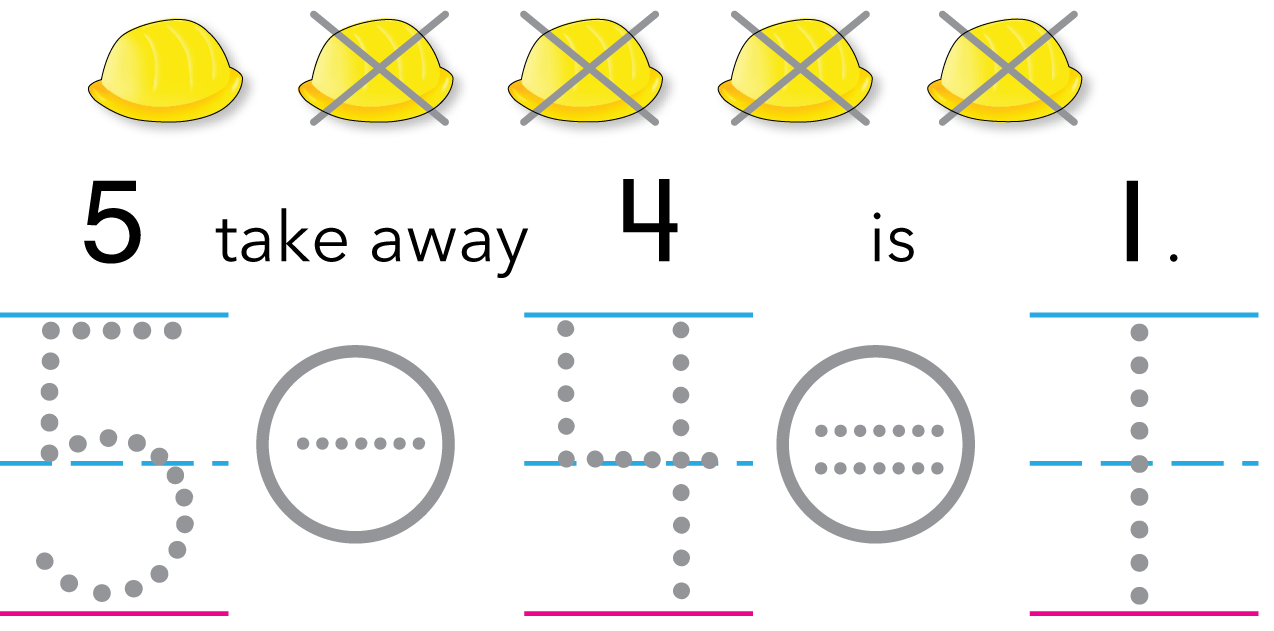
This topic emphasizes understanding subtraction as “taking apart” or “taking from” (or “taking away”). Your child will learn how to complete sentences and use fingers, objects, drawings, and written equations to show and explain subtraction. Your child will cross out objects to show that they are being taken away and write how many are left.

Your child will also take apart a whole to make two parts and then tell how many objects are in each part.

As the topic progresses, your child will fill in more missing numbers to complete subtraction sentences.
Your child will also learn to use an equation to represent subtraction.
SOLVE REAL-WORLD PROBLEMS
Working with real-world examples of “taking apart” and “taking from,” your child will represent subtraction situations using objects, drawings, and equations. Your child will see how each object, picture, or part of an equation represents a quantity in the real-world problem.
FLUENCY
Your child will begin to develop fluency with subtraction within 5 by finding patterns in subtraction facts. Your child will start to see part-whole relationships and notice patterns, such as if zero is subtracted from a number, the difference is that number. Being able to find patterns will help your child develop the ability to subtract fluently—that is, without having to count on fingers or use other tools. Your child may notice in an organized list of facts for one number (5 in this example) that the difference decreases when the number being subtracted increases.
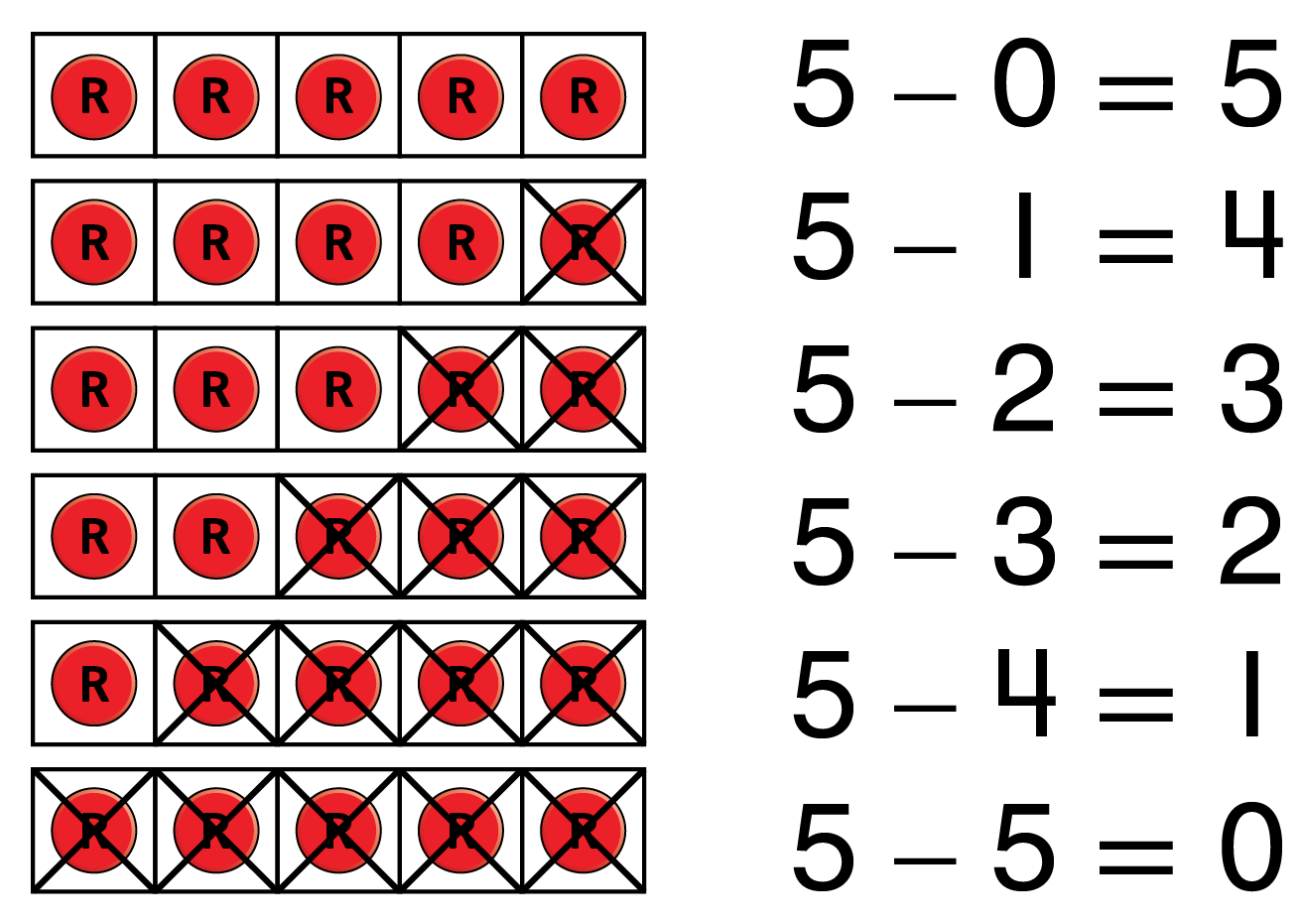 First row: 5 counters with none crossed out and the equation 5 minus 0 = 5; Second row: 5 counters with 1 crossed out and the equation 5 minus 1 = 4. Third row: 5 counters with 2 crossed out and the equation 5 minus 2 = 3. Fourth row: 5 counters with 3 crossed out and the equation 5 minus 3 = 2. Fifth row: 5 counters with 4 crossed out and the equation 5 minus 4 = 1. Sixth row: 5 counters with 5 crossed out and the equation 5 minus 5 = 0.
CONNECT THE MATH
You can connect the math in this topic to everyday experiences. Create “take apart” and “take from” (or “take away”) situations at home and when you are out with up to 10 objects. For example, you might ask, “If this sandwich is cut into 4 pieces and you eat two of them, how many pieces will be left?” or “How can you take apart the 4 pieces for you and your sibling?”
Topic 5 Lessons
-
Lesson 5-1
-
Lesson 5-2
-
Lesson 5-3
-
Lesson 5-4
-
Lesson 5-5
-
Lesson 5-6
-
Lesson 5-7