TOPIC 4
Understand Addition
OVERVIEW
Topic 4 introduces your child to the concept of addition and focuses on understanding addition as “put together” and “add to.” Your child will learn to represent addition in different ways and use addition to solve real-world problems. The work in this topic builds toward fluently adding within 5.
MEANINGS OF ADDITION
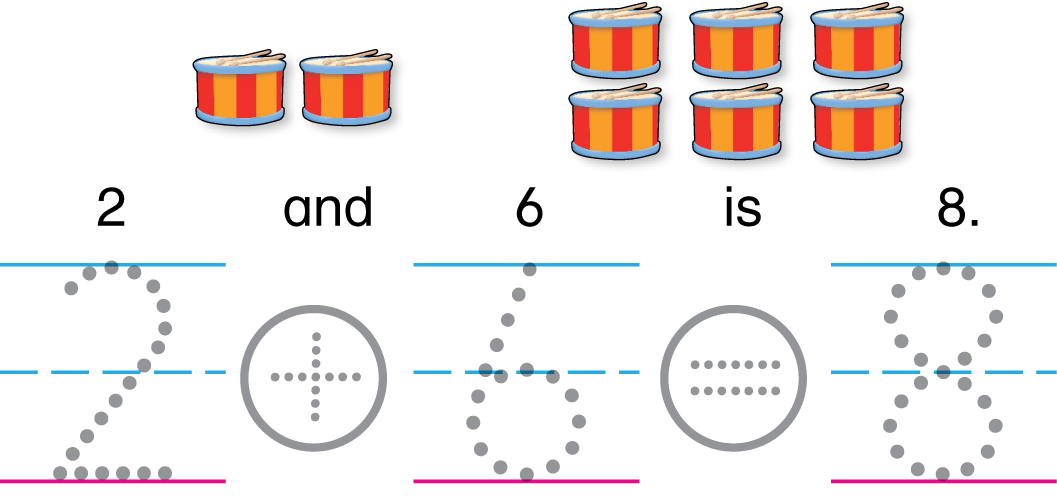
This topic emphasizes understanding addition as “putting together” two groups or “adding to” a given group. Your child will complete sentences and use fingers, objects, drawings, and written equations to show and explain addition. Your child will complete addition sentences by counting objects in two groups that are put together.
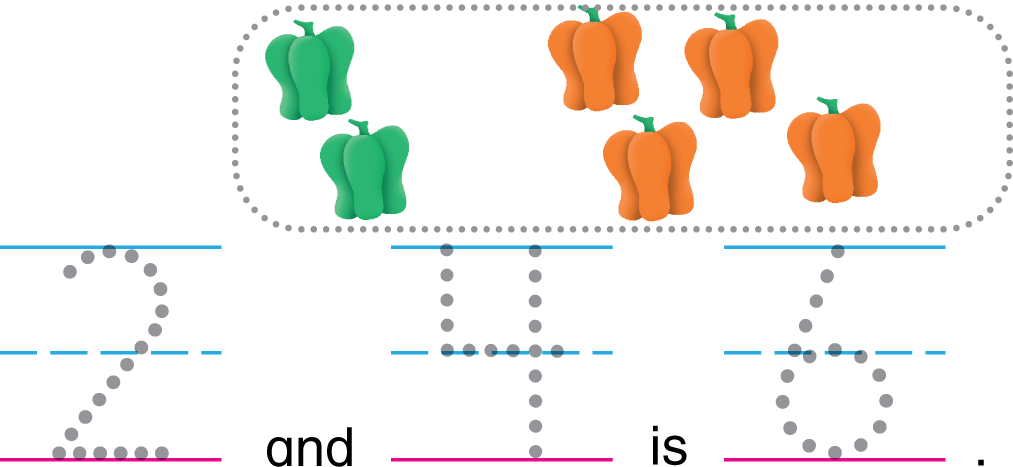
Your child will also learn to use an equation to represent addition.
SOLVE REAL-WORLD PROBLEMS
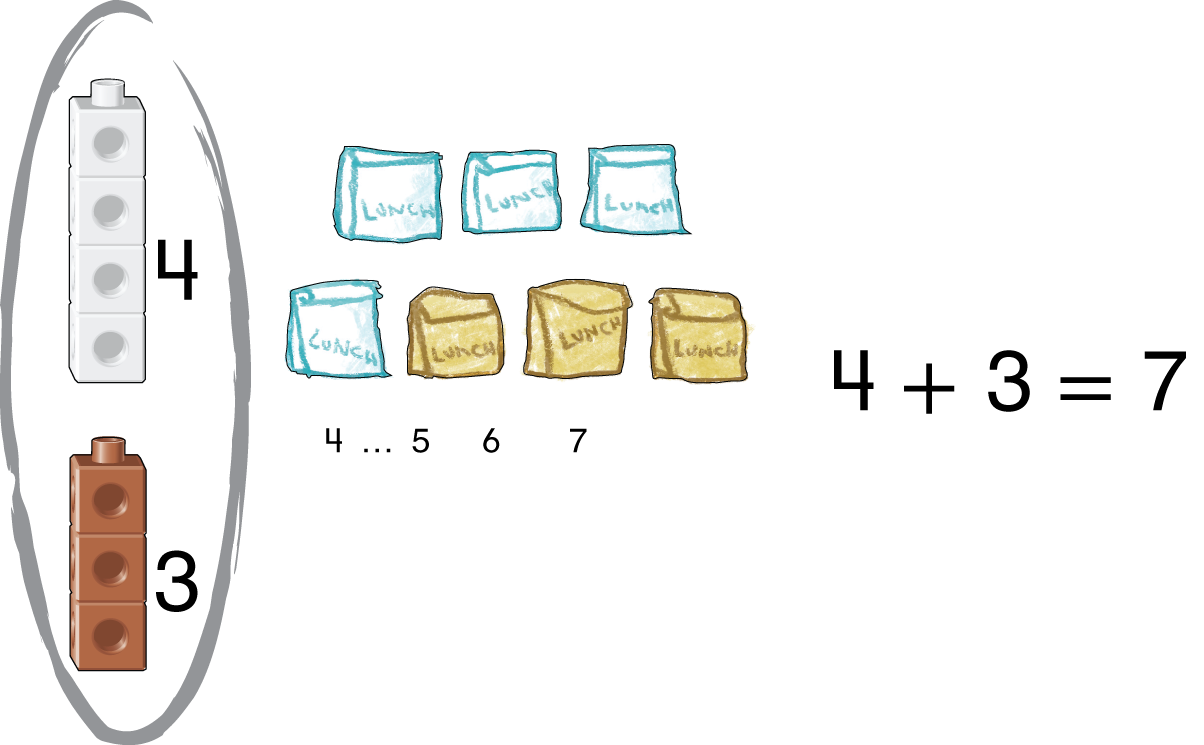
Working with real-world examples of “putting together” and “adding to,” your child will represent addition problem situations using objects, drawings, and equations. Your child will see how each object, picture, or part of an equation represents a quantity in the real-world problem.
FLUENCY
Your child will begin to develop fluency with addition within 5 by finding patterns in addition facts. Your child will start to recognize that numbers can be added in any order. Recognizing patterns will help your child develop the ability to add fluently—that is, without having to count on fingers or use other tools.
One pattern your child may notice in an organized list of facts for one number (5 in this example) is that if one of the two addends increases and the other addend decreases by the same amount, the sum stays the same.
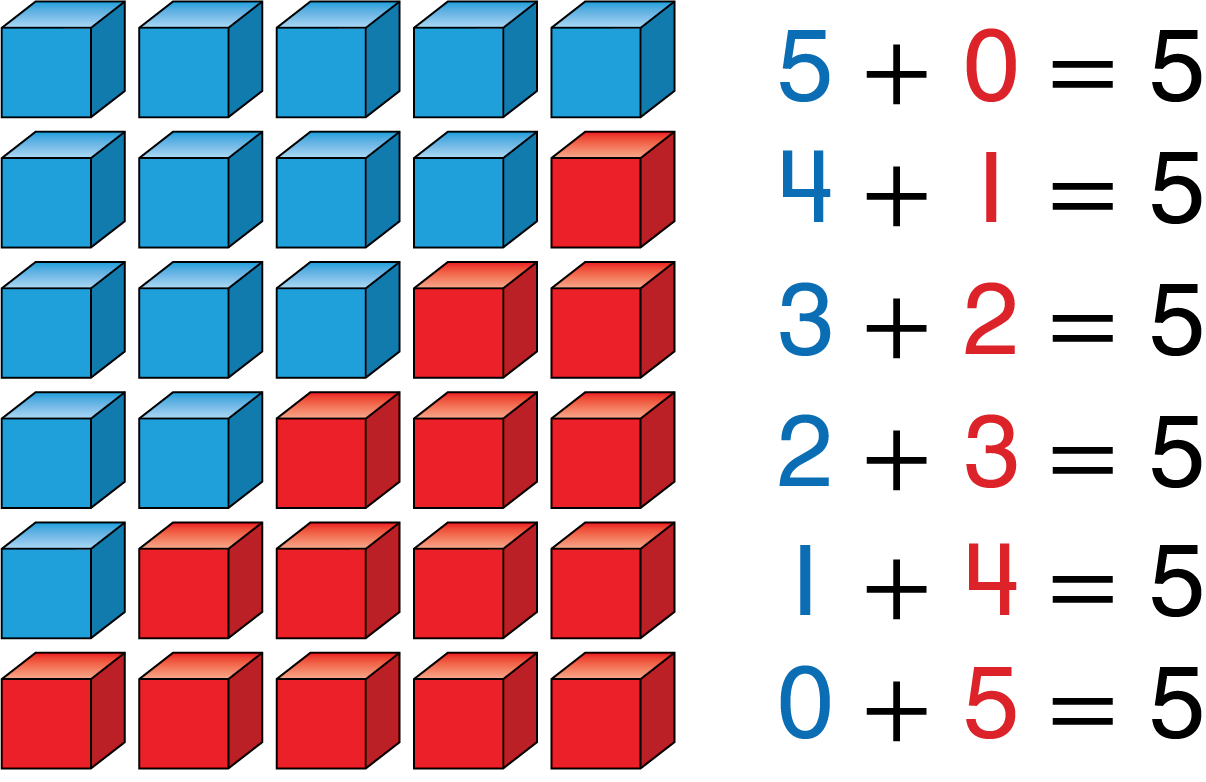 First row: 5 blue cubes. The equation is 5 plus 0 equals 5. Second row: 4 blue cubes, 1 red cube. The equation is 4 plus 1 equals 5. Third row: 3 blue cubes, 2 red cubes. The equation is 3 plus 2 equals 5. Fourth row: 2 blue cubes, 3 red cubes. The equation is 2 plus 3 equals 5. Fifth row: 1 blue cube, 4 red cubes. The equation is 1 plus 4 equals 5. Sixth row: 5 red cubes. The equation is 0 plus 5 equals 5.
CONNECT THE MATH
You can connect the math in this topic to everyday experiences. Create “put together” and “add to” situations at home and when you are out. For example, you might ask, “If we add 2 more cans of beans to the cans that are already in our grocery cart, how many will we have?” Challenge your child to find the total amount by both counting on and putting together. Finally, have your child take 5 objects and show all the different ways to make 2 groups of different quantities from them.
Topic 4 Lessons
-
Lesson 4-1
-
Lesson 4-2
-
Lesson 4-3
-
Lesson 4-4
-
Lesson 4-5
-
Lesson 4-6
-
Lesson 4-7