TOPIC 8
Analyze, Compare, and Create Shapes
OVERVIEW
Topic 8 deepens geometric understandings of two- and three-dimensional shapes. Your child will analyze and compare attributes of shapes shown in different sizes and orientations. By knowing the attributes, or characteristics of the shapes, your child will identify the shapes no matter what size they are or how they are oriented. This topic also explores combining 2-D shapes to make other 2-D shapes and combining 3-D shapes to make other 3-D shapes.
ANALYZE AND COMPARE SHAPES
Analyze and Compare 2-D Shapes Your child will analyze and compare 2-D shapes based on attributes, such as number of sides, length of sides, number of vertices, and being round. Students identify shapes as triangles, rectangles, squares, and circles regardless of their size and orientation.
Some problems will give your child a set of clues. Your child will mark an X on shapes that do not fit the clues and circle any shapes the clues describe.
 I have 4 sides. I do NOT have 4 sides that are the same length. What shape am I?
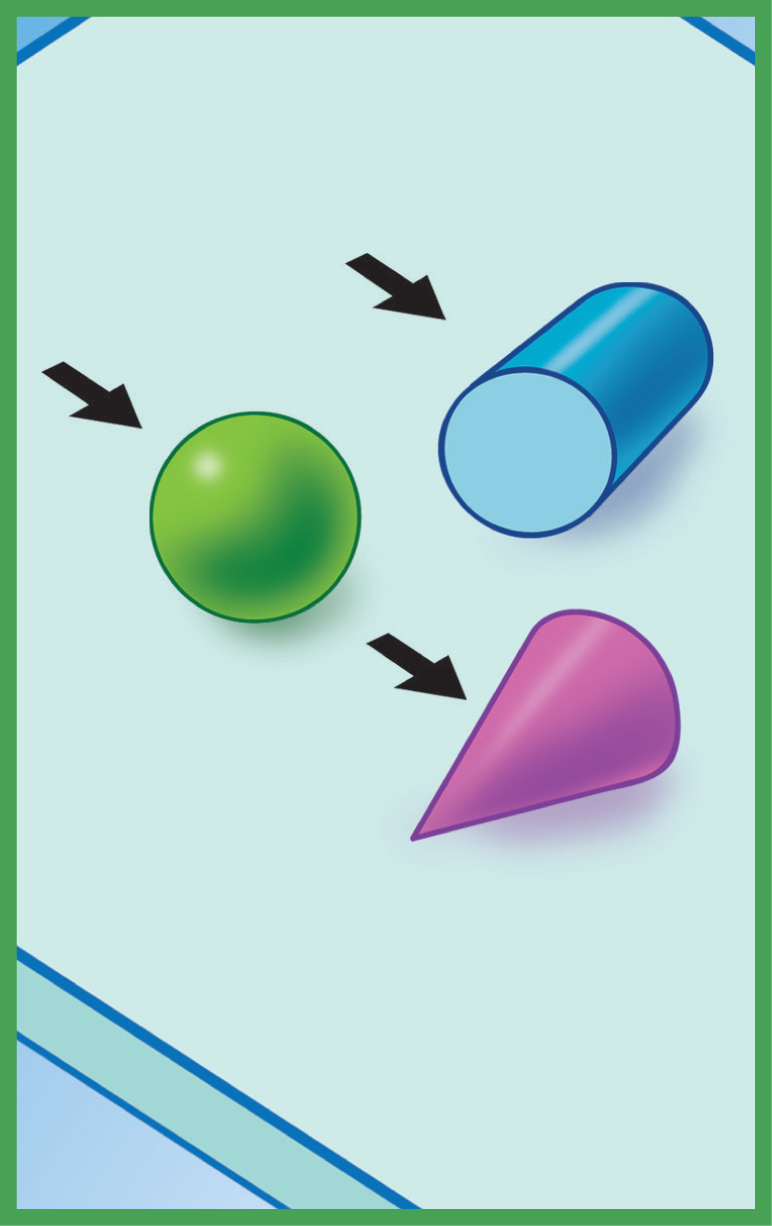
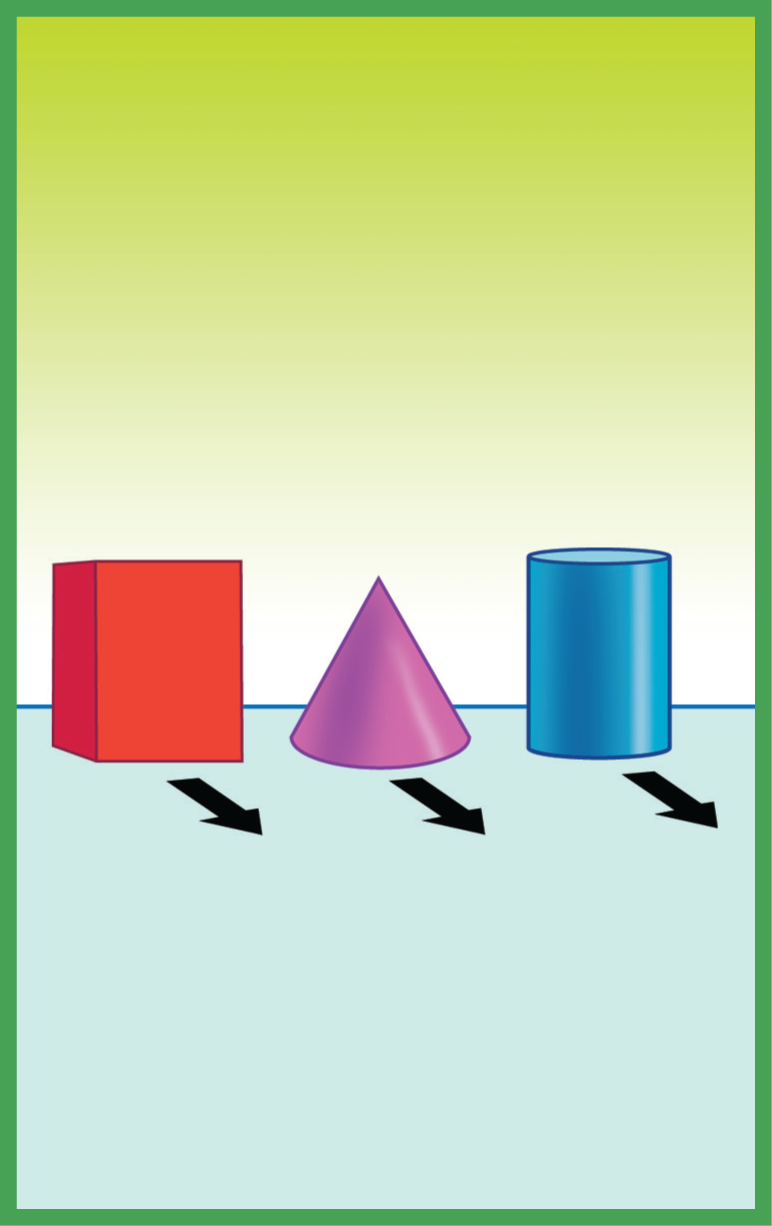
Analyze and Compare 3-D Shapes Your child will analyze and compare 3-D shapes based on the attributes of whether the shapes roll, slide, and/or stack. In this picture, your child will identify a sphere, a cylinder, a cone, and a cube.
 Cubes, cylinders, and cones can stack on other shapes. Spheres, cylinders, and cones can roll.
Cubes, cones, and cylinders can slide.
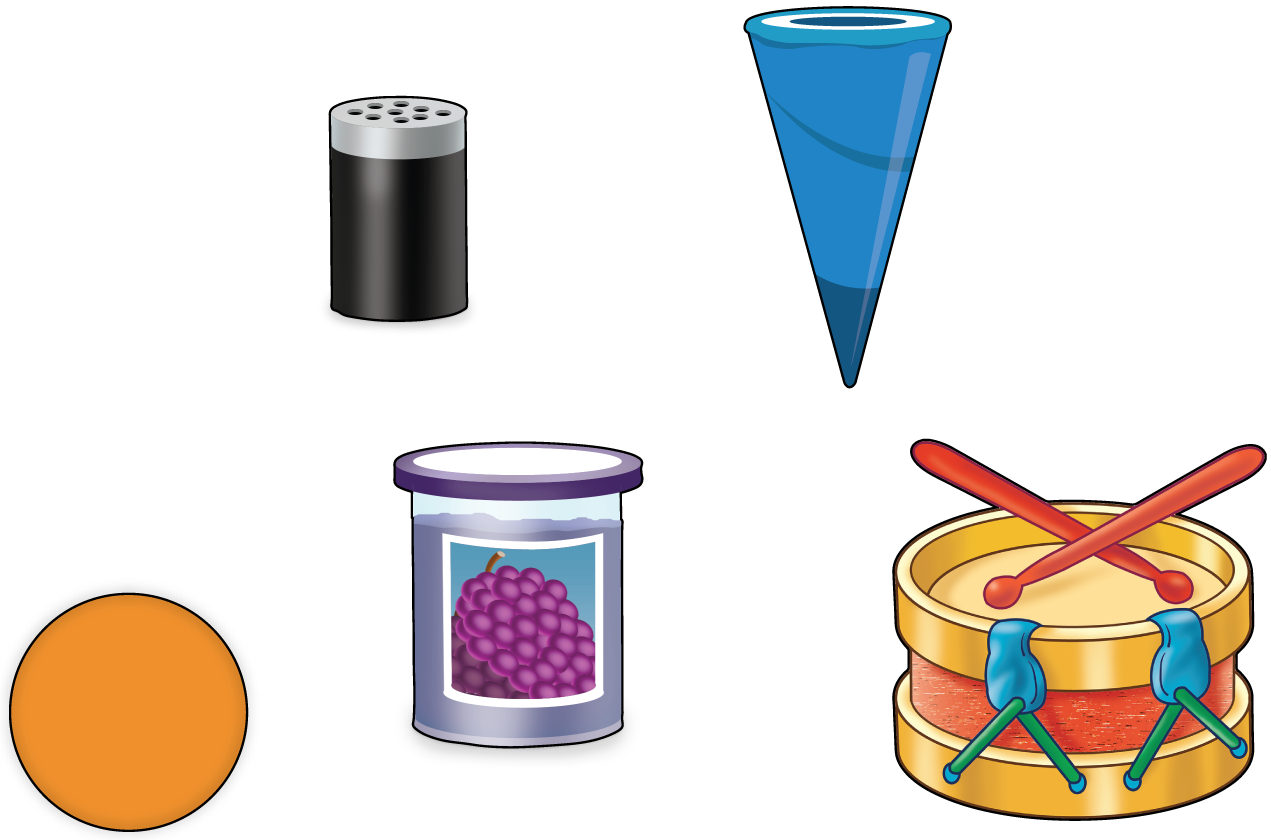
 Find 2-D Shapes on 3-D Shapes Your child will match 2-D shapes (squares and circles) with 3-D shapes that have a flat surface with that shape.
Here are 3-D shapes that have a flat surface that looks like a circle.
CREATE AND COMPOSE SHAPES
Compose 2-D Shapes to Form Larger 2-D Shapes Your child will put together several 2-D shapes to form a larger one.
Your child will solve problems that ask how many of the small shape are needed to make the larger shape.
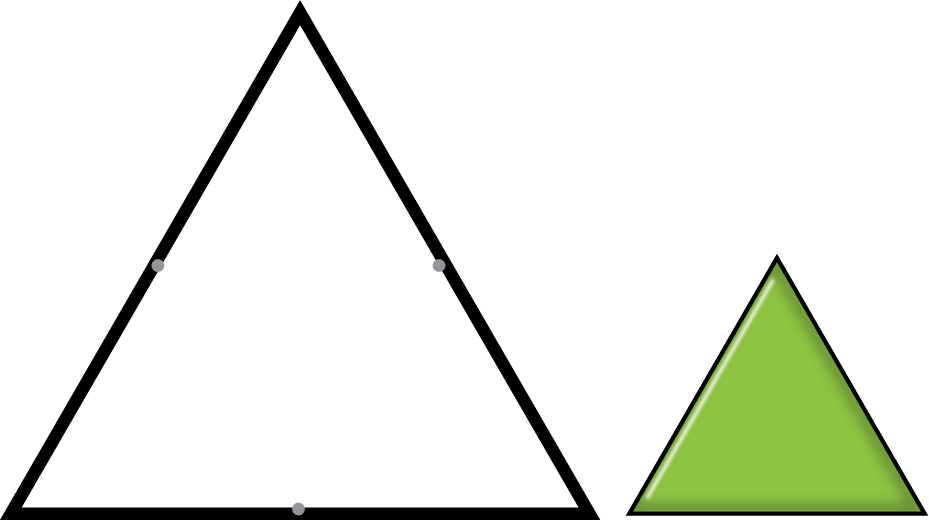 You child will cover the larger shape with pattern blocks to find the answer.
Create 3-D Models of Real-World Objects Your child will use geometric shapes to create models of real-world objects by combining and stacking 3-D shapes to form the shape of the object.
Your child will be asked to use 3-D materials to model, draw, and name a real-world object.
CONNECT THE MATH
You can connect the math in this topic to everyday experiences. Have your child look for two- and three-dimensional shapes in your home or when you go out. At the grocery store, for example, you might ask your child to find 3 different sizes of cylinders (a soup can, an oatmeal container, and a jelly jar); or find 3 objects that are made of rectangles (a cereal box, a paper bag, a picture frame). As your child notices three-dimensional objects in your environment, talk together about which 3-D shapes combine to make the overall shapes.
Topic 8 Lessons
-
Lesson 8-1
-
Lesson 8-2
-
Lesson 8-3
-
Lesson 8-4
-
Lesson 8-5
-
Lesson 8-6
-
Lesson 8-7
-
Lesson 8-8
-
Lesson 8-9