TOPIC 7
Identify and Describe Shapes
OVERVIEW
Topic 7 is a formal introduction to geometric ideas. Your child will learn to name and categorize two-dimensional (flat) and three-dimensional (solid) shapes. Your child will also describe the relative position of an object in its environment using position words such as above, below, beside, next to, in front of, and behind.
NAME SHAPES
Circles and Triangles Your child will identify circles and triangles. By understanding that a circle is a round shape, your child will identify real-world objects that are circles. By understanding that a triangle is a shape with 3 sides and 3 vertices, your child will identify real-world objects that are triangles. A vertex is the point where two sides meet. Squares and Other Rectangles Your child will learn that a square is also a rectangle. The idea that a shape can belong to two categories is an important concept in geometry. Your child will identify squares and rectangles regardless of their orientation or size. In Kindergarten, most children are at the “visual” level of geometric thinking. Your child may say that a rectangle “looks like a door” or it “looks like a bill.” Your child will move to a “descriptive” level, with awareness of attributes. For example, your child will learn to say that a square “has 4 sides that are all the same length.” Solid Shapes
Your child will learn to identify four types of solid shapes—spheres, cubes, cylinders, and cones—and objects around them that resemble these solid shapes. In this picture, your child will identify a sphere, a cylinder, a cone, and a cube.

DESCRIBING RELATIVE POSITIONS OF SHAPES
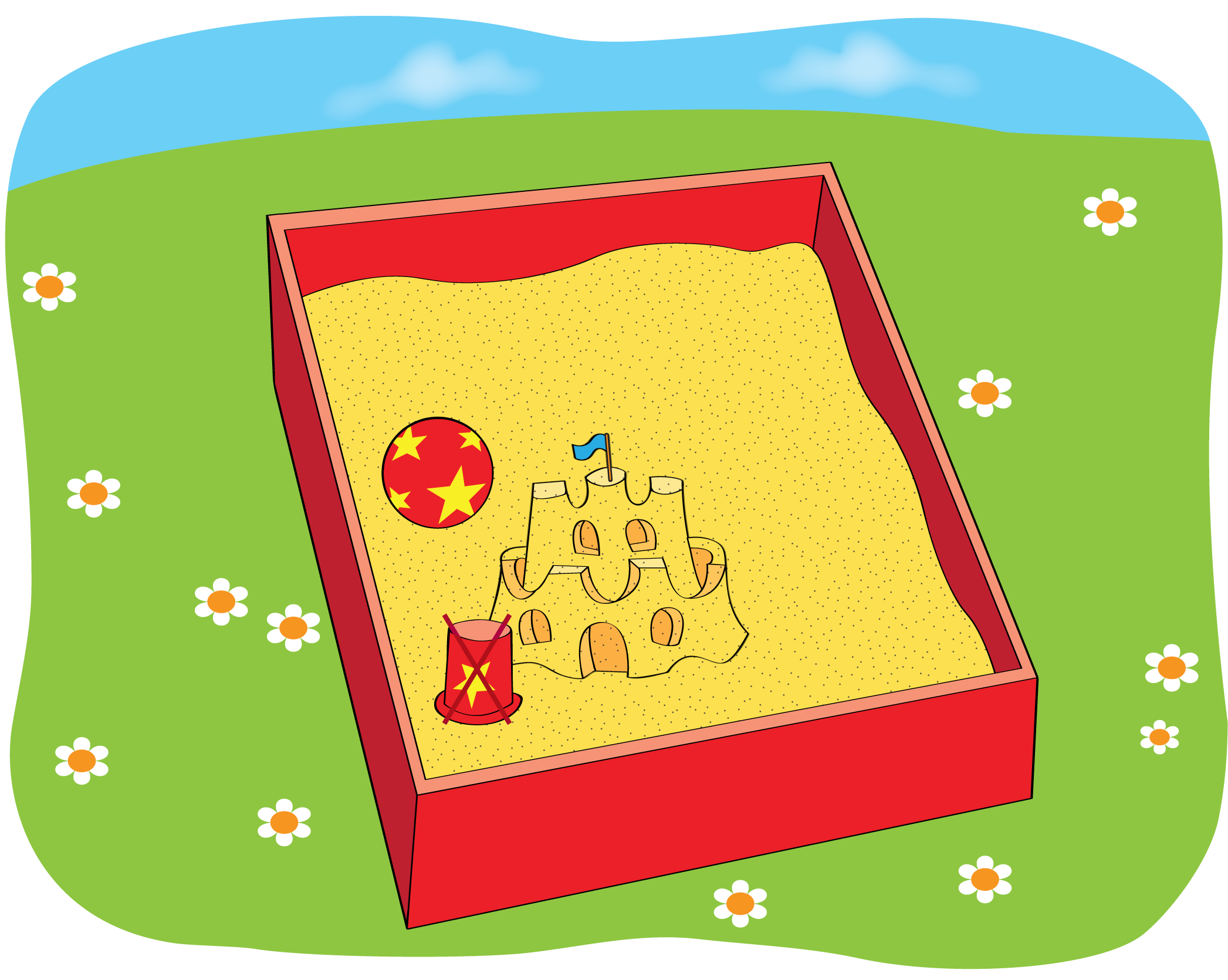
Positional Language Your child will understand positional language such as above, below, next to, beside, in front of, and behind and use the terms to describe the location of objects.
In this problem, your child will draw an X on the object in front of the sandcastle that looks like a cylinder. Then your child will draw an object that looks like a cube next to the sandbox.
CONNECT THE MATH
You can connect the math in this topic to everyday experiences. Play “I Spy” by looking around a room for the 2-D and 3-D shapes your child knows. Say, “I see a triangle on the floor. Can you find it?” Then switch roles and have your child point out shapes that can be seen in real-world objects at home or when you go out. For example, looking at a basketball, your child might say, “That’s a sphere!” Looking at a window, your child might see a square or two rectangles.
Topic 7 Lessons
-
Lesson 7-1
-
Lesson 7-2
-
Lesson 7-3
-
Lesson 7-4
-
Lesson 7-5
-
Lesson 7-6
-
Lesson 7-7
-
Lesson 7-8
-
Lesson 7-9